

This report was developed by the Beef Cattle Research Council for Alberta Beef Producers. It offers a summary of the BCRC’s Year-in-Review Report, and is a reflection of activities between July 1, 2025 and June 30, 2026.
Beef Producer National Check-Off Investments in Research
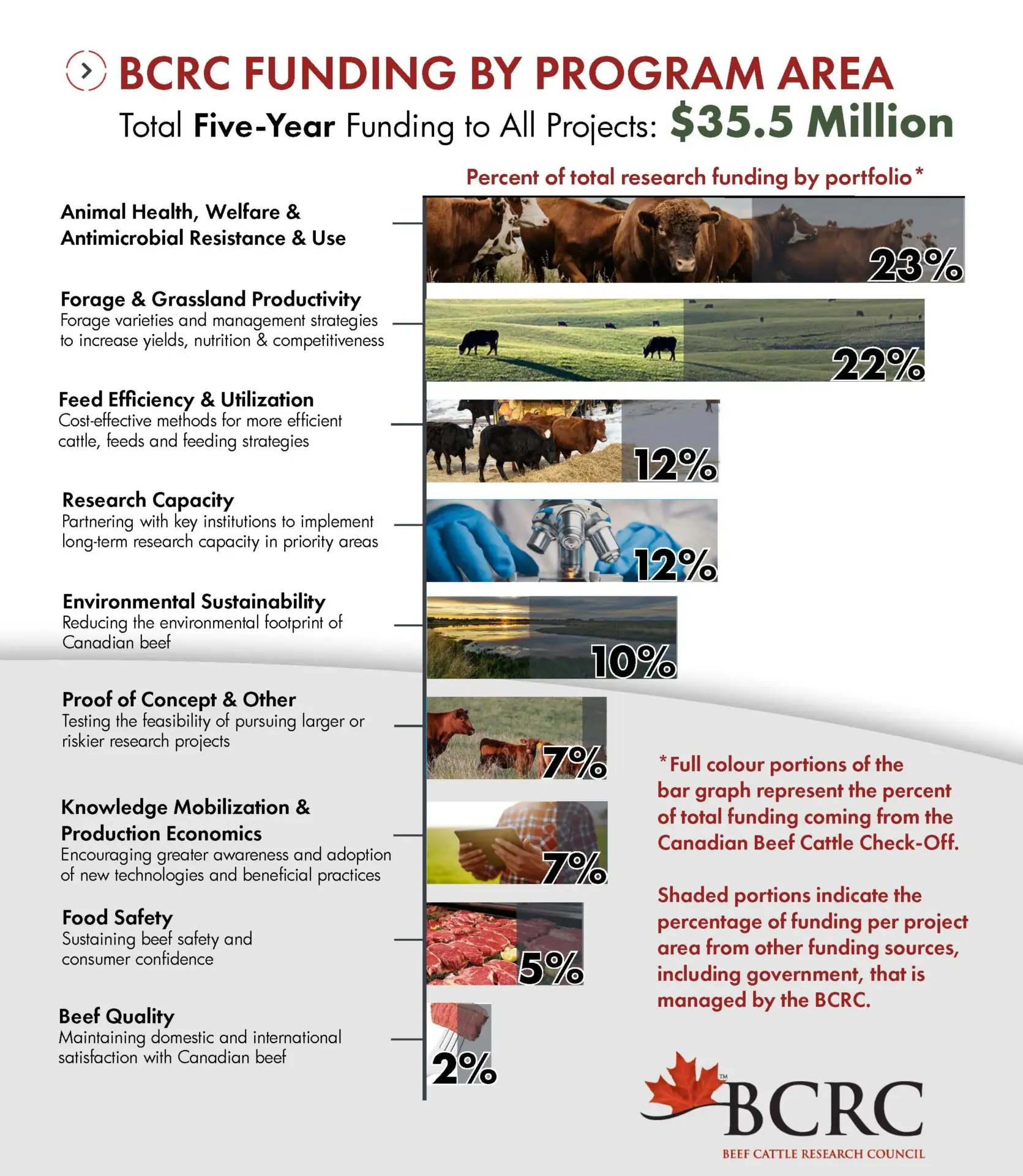
The Beef Cattle Research Council (BCRC) is Canada’s industry-led funding agency for beef, cattle and forage research and knowledge mobilization. The BCRC is directed by a committee beef producers from across the country, including six from Alberta. It is funded primarily through the research allocation of the Canadian Beef Cattle Check-Off.
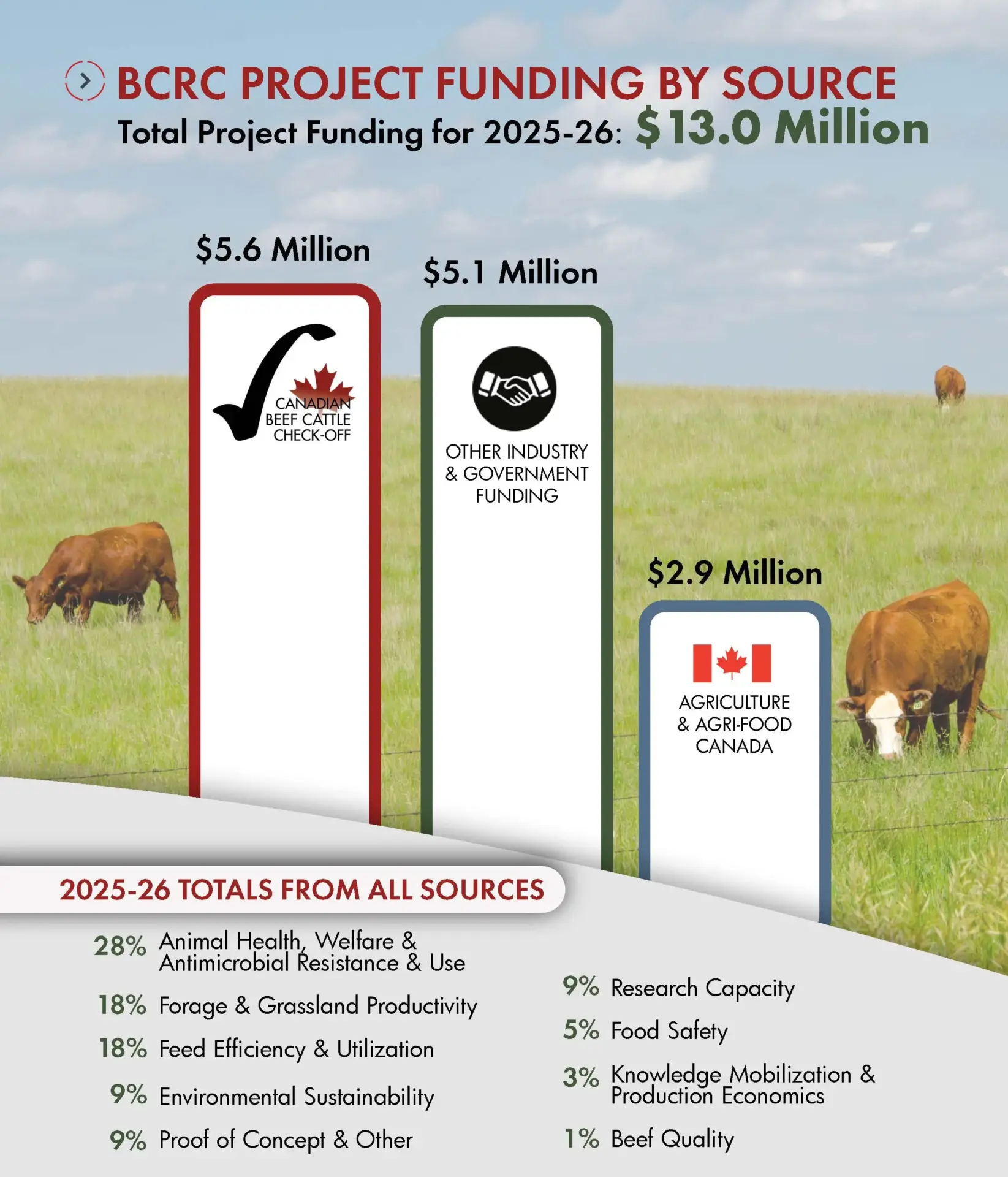
In 2025-26, the BCRC received on average $0.66 (unaudited) of every $2.50 of the Canadian Beef Cattle Check-Off collected by the provinces. This funding was leveraged under the Beef and Forage AgriScience Cluster IV program with Agriculture and Agri-Food Canada (AAFC) Sustainable Canadian Agricultural Partnership, where industry contributed 54% ($2.88 million) and AAFC contributed 46% ($2.46 million) in 2025-26. In addition, the BCRC leveraged the Canadian Beef Cattle Check-Off for an additional $4.97 million in research funding and $89,000 in-kind from government and industry partners through initiatives outside of the Cluster. It total, 23 research projects were funded by the Cluster in 2025-26, 51 Priority Research projects and 17 Proof of Concept projects.
The BCRC uses expert advice, independent peer review, industry feedback and strategic priorities to ensure research funding decisions are fair, transparent and focused on practical, scientifically sound projects. The BCRC also supports knowledge mobilization to promote beneficial practices and connect research with producers and industry through practical, accessible resources.
Research Project Spotlights
Developing a Rapid, Chute-Side Diagnostic Test to Inform BRD Treatment
Bovine respiratory disease (BRD) continues to be the biggest animal health challenge to the Canadian cattle feeding sector. A proof-of-concept study led by Dr. Michael Jelinski (Veterinary Agri-Health Services Ltd.) found significant differences in serum haptoglobin levels within the health cohorts examined. This supports previous work demonstrating haptoglobin is a good marker of BRD and correlates with disease severity. Work is ongoing to improve speed with the goal of using the technology chute side. The use of a confirmatory test in conjunction with visual pen checking and rectal temperature assessment will improve health outcomes and reduce antibiotic use.
Vaccination Programs to Improve Calf Health
Developing new vaccines is very costly, but we can potentially make the vaccines we already have work better. Studies led by researcher Dr. Nathan Erickson (Western College of Veterinary Medicine, University of Saskatchewan) indicate that vaccinating (priming) young calves with an intranasal vaccine and boosting them with an injectable vaccine resulted in good protection and development of a robust immune response that likely developed immune memory persisting to the high-risk weaning period. Overall, it appears that prime-boost provides superior protection and a lower potential for virus shedding than a protocol that uses only a single injection of a modified-live vaccine at a young age.
Quantifying the Value of Wetlands on Pastureland
This project, led by Dr. Pascal Badiou (Ducks Unlimited), has provided the first estimate of the total area of wetlands located within beef production landscapes of the Canadian Prairies and demonstrates that a substantial portion of wetlands in this region (~2 million hectares) are embedded in these landscapes. The work also suggests that wetlands within perennial landscapes, such as those associated with beef production, emit significantly less methane and overall greenhouse gas emissions (expressed as CO2 equivalents).

Producer Resources and Engagement
The BCRC’s knowledge mobilization work continues to gain momentum, with growth in followers and subscribers across all platforms compared to the previous fiscal year. The 2025-26 content output included 65 timely articles (44 translated to French), 36 research factsheets, 12 monthly e-newsletters, 47 podcast episodes, 12 articles for Canadian Cattlemen – The Beef Magazine, 35 new infographics, two new interactive calculators (three translated into French), two videos, four webinars, 18 staff presentations and three new webpages. Three BCRC social media reels generated more than 2 million views on Facebook as part of the consistently popular #Calf911 initiative.
Key activities included strengthening collaboration through the Canadian Beef Knowledge Mobilization Network, supporting regional extension activities, working with veterinary professionals to distribute producer resources and developing practical resources for management of stock water and to improve genetic literacy among Canadian beef producers.
With input from more than 500 members of Canada’s beef industry, the BCRC and its industry partners released a renewed Five-Year Canadian Beef Research & Knowledge Mobilization Strategy to encourage collaboration and targeted funding toward high-priority beef research and extension objectives. The Strategy provides a coordinated national framework to align investment, accelerate innovation and ensure research outcomes lead to measurable impact.
Subscribe to the BCRC
Verified Beef Production Plus
Under the umbrella of the BCRC, Verified Beef Production Plus (VBP+) delivers training and certification services to beef producers across Canada, supporting recognition of safe, sustainable and socially responsible production practices. Program growth has continued, with 1,272 active VBP+ Certified operations (381 from Alberta), up from 1,221 in 2025. In total, 6,662 producers have completed VBP+ training, up from 6,542 in 2025.
Elevating the presence of VBP+ on social media and regular producer communications has been a significant focus of the BCRC in the past year. The BCRC and VBP+ teams have reviewed and revised website elements and key webpages and jointly published six new resources. These resources include guides on cleaning & disinfecting, hosting on-farm tours, contamination of hides and meat, consumption of foreign materials and toxins, and an update to our popular injection techniques guide.
2025-2026 Year in Review Showcases Impacts of Beef Producer Investments
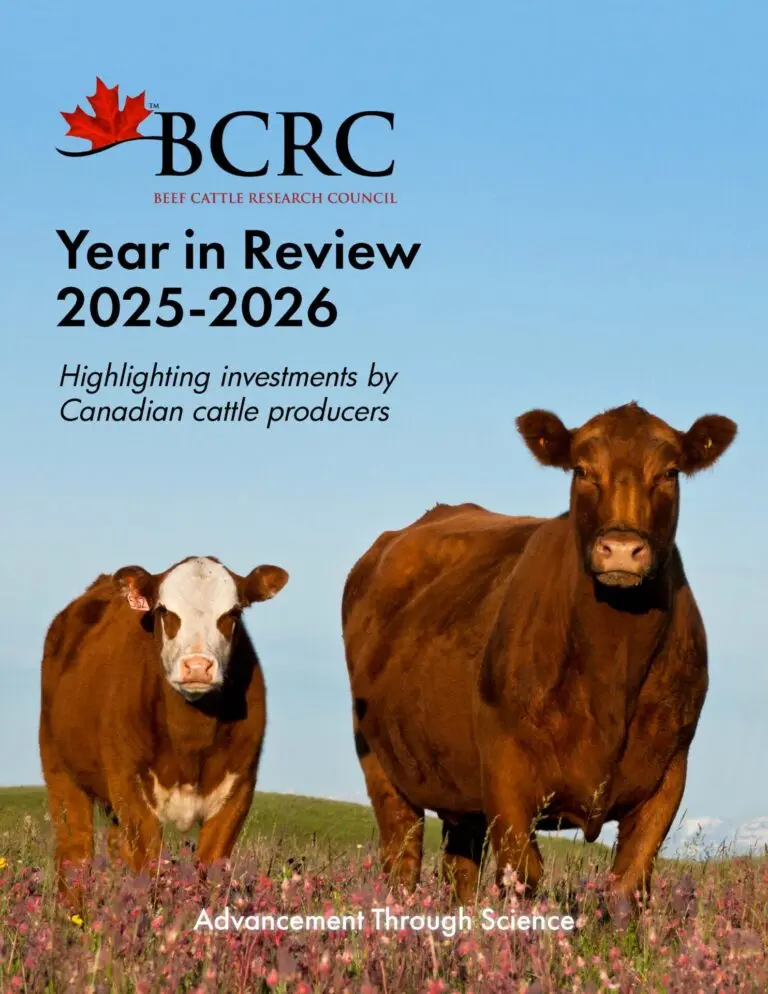
The Beef Cattle Research Council’s 2025–2026 Year in Review highlights how producer investments and input are advancing research, addressing industry priorities and delivering practical value back to Canada’s beef producers.